Aufbau teaches chemistry — and nuclear physics — by computing it, not looking it up
Aufbau teaches chemistry — and nuclear physics — by computing it, not looking it up.

Most learning apps show you an answer pulled from a database. Aufbau keeps none — it derives structure and reactivity from a few interpretable principles you already know, and lets the behavior emerge. The only things it stores are the measured nuclear values no formula gets right.

Give it atoms and it computes how they bond, because every structure minimizes the same energy score, not because anyone typed it in. Covalent, ionic, metallic, and coordinate bonds fall out of one electronegativity comparison, and the Hückel rule finds aromatic rings uniformly.

That refusal reaches the periodic table itself. Every element's configuration is derived from the aufbau principle, never read from a stored table — so the math doesn't stop where the real elements do. Hand Aufbau any atomic number up to 20,000 and it works out the shells and orbitals the same way.

Shape comes from the same idea. Put domains on a sphere, let them push apart, and water bends — no hybridization, no new orbital story for every count. Then open Sculpt and argue with the result: ask for the geometry you want, and the engine reports what it costs — or tells you the molecule never reached it.

Seven lessons work each question out on screen rather than stating it — why molecules bend, why a mixture will not react, how to plan a route backwards. Every number is computed live, and a lesson asked something outside itself says so.

Reactions become a search for energy-lowering steps to a target, so a multistep synthesis — even assembling a porphyrin from small precursors — is calculated, not transcribed. Temperature and pressure move the free energy, catalysts remove barriers, and retrosynthesis runs the engine in reverse, proposing a disconnection and validating it by rebuilding the target — inserting a protecting group when a step would hit the wrong site. Selectivity falls out the same way — Woodward–Hoffmann rules from the π-orbital coefficients, and hard–soft matching for which ligand grabs which metal.

In the Chemistry Workbench you type any formula, set the temperature, and get an honest verdict with the energy change.

One principle carries all the way to the nucleus. Binding energy turns capture, decay, fission, and fusion into one question: does it release energy?

All of it is checked against measurement. An extensive test suite compares what the engine derives against published values — reaction enthalpies, entropies, binding energies — and pins the places it is wrong, at the size it is wrong, so they cannot drift unnoticed. Where the model reaches its limit, Aufbau says so on screen.

FEATURES
• A computed periodic table — any atomic number to 20,000, configuration from the aufbau rule
• Bonds by energy minimization: covalent, ionic, metallic, coordinate — all emergent
• Aromaticity and delocalization, including macrocycles (heme, chlorophyll)
• Shape from domains on a sphere, plus Sculpt for designing a geometry and reading its cost
• Seven lessons that derive the chemistry instead of asserting it
• Synthesis planning, retrosynthesis with protecting groups, catalysts, temperature, pressure
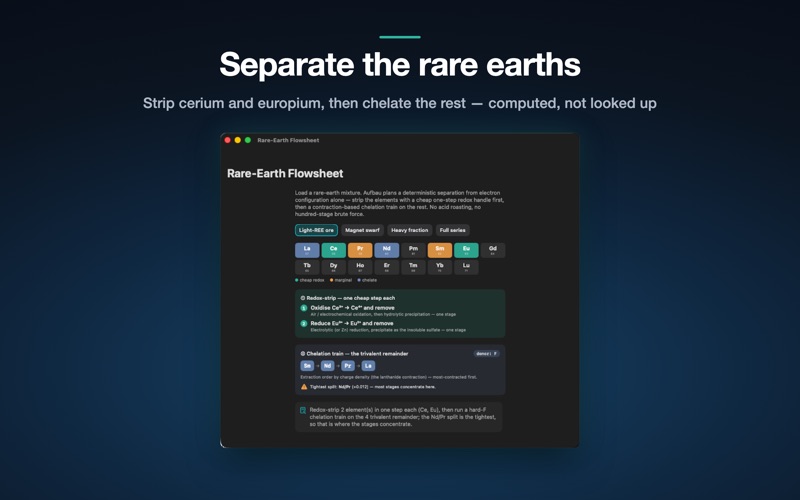
• Orbital-derived selectivity: pericyclic rules, stereochemistry, rare-earth separation
• Chemistry Workbench: react any typed formula, get an honest verdict, build a library
• Every product in rotatable 3-D: geometry, element legend, aromatic π clouds
• A unified nuclear engine: capture, decay, fission, fusion — chained onto chemical routes

For undergraduate and advanced high-school chemistry — general through introductory organic — plus a nuclear module. For instructors who want to show why, and students who want to see it.

Aufbau is an interpretable teaching model, not a research-grade predictor. Every result traces to the principle that produced it.

Fully offline. No account. No data collection. No ads.